
Best AI Educational Video Generators in 2026
Synthesia, HeyGen, Pictory, OiiOii, Steve.ai and Canva compared by the job they actually do, plus the four-scene test to run during any trial.
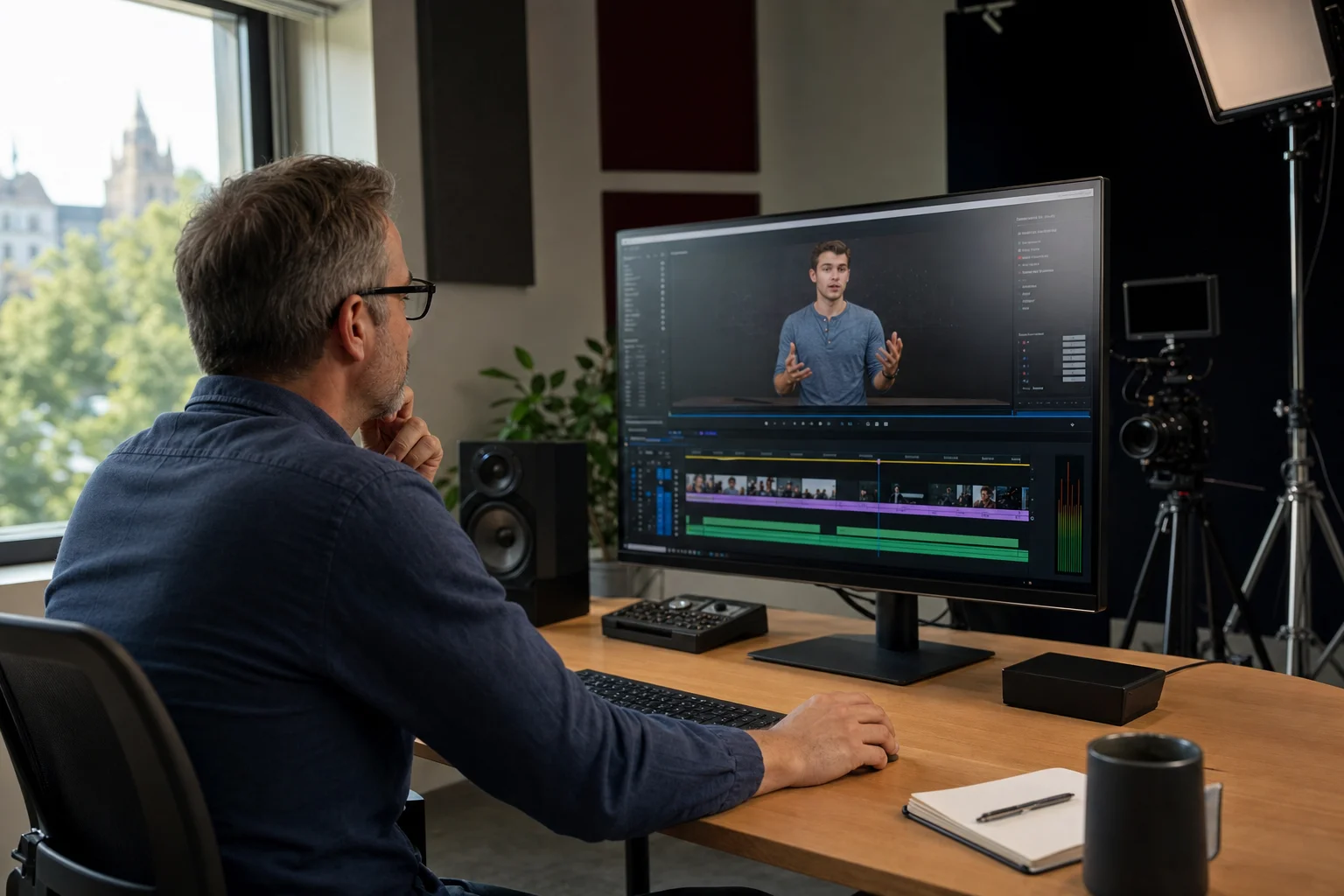
"AI educational video generator" describes two different products, and choosing badly is the most common mistake in this category. One group turns a script into an avatar presenting it. The other builds an animated lesson with characters and scenes. Both are legitimate; they fail at opposite things. This guide sorts the main options by which job they actually do.
One rule before the list: judge any of these on a four-scene lesson, not a single clip. Every tool here produces an impressive individual scene. What separates them is whether scene four still matches scene one.
The talking-head group
These convert a script into a presenter reading it, with captions and slides. Fast, predictable, strong at multi-language output.
Synthesia
The enterprise default. Large avatar library, extensive language support, and the compliance and workspace controls large organisations ask for. Best fit for policy modules, system walkthroughs and course announcements that need to exist in many languages quickly. It does not animate a scenario; it presents one.
HeyGen
Closest competitor to Synthesia, with particular strength in avatar realism and translation that keeps lip movement plausible. Popular with marketing teams as well as L&D, which shows in the output — polished, presenter-first. Same structural limit: the presenter is the video.
Pictory
Aimed at turning existing material — a blog post, a webinar recording, a long script — into short video with stock footage and captions. Genuinely useful for repurposing an archive. The visuals come from a library rather than being built for your concept, so it suits summary content more than explanation.
InVideo
Template-driven, broad, and fast for social-shaped output. Education is one of many use cases rather than the focus. Good when you need volume and shape variety; weaker when a lesson needs a specific visual carried across scenes.
The animated-lesson group
These start from the story rather than the script-reader, and are the right category when the teaching itself is visual.
OiiOii
Built as an animation platform rather than an avatar platform, with the emphasis on keeping characters and scenes coherent across a full lesson rather than producing one clip at a time. Its educational video generator targets exactly the case the talking-head tools cannot serve — a lesson told as a narrative, with a character the learner follows from scene to scene. Worth testing against the four-scene check, which is the test it is designed to pass.
Steve.ai
Longer-established in animated explainer video, with a script-to-animation flow and a large asset library. Strong for classic explainer shapes — the whiteboard-style or flat-vector lesson. Style range is bounded by the library, which is a fair trade for speed.
Animaker
Character-driven animation aimed at non-designers. Slower than a script-to-video generator because you are assembling more directly, and correspondingly more controllable. A reasonable middle ground when you want animation but need to direct it precisely.
The general-purpose tools worth knowing
Canva
Not primarily an AI video generator, but it has absorbed enough AI features that many teachers never need anything else. Templates, recording, simple animation and a genuinely low learning curve. For lightweight lesson video attached to slides, it is often the correct answer, and it is already in the institution's licence.
ChatSlide
Starts from a document or a deck rather than a prompt. You import a PDF, a set of slides or a link, and it produces a presentation and then a narrated video from it, with voiceover and captions. The ability to turn slides into narrated video makes it the practical option when the teaching material already exists in some other form, which in most institutions it does. It is not an animation tool and does not try to be.
Luma AI and similar generative video models
These generate short cinematic clips from a prompt. Remarkable output, wrong unit of work for teaching — clips rather than lessons, and continuity across shots is the known weak point. Useful as a source of individual visuals inside a lesson built elsewhere.
How to choose in practice
Ask what the lesson needs to show. If the content is a person explaining a policy, buy a talking-head tool and stop there. If the content is a process, a scenario, or a narrative, buy an animated-lesson tool. Most disappointment comes from using the first for the second.
Run the four-scene test during the trial. Build one real lesson where scenes two and four share a character and a diagram. Compare them. This takes fifteen minutes and predicts nearly everything about your editing burden later.
Check revision cost. Educational content is corrected constantly. Establish whether one scene can be regenerated alone, or whether a five-word fix rebuilds the whole video.
Check caption export. Captions must be a file you can edit, not text burned into the frame, or the video will fail accessibility review.
Check aspect ratios. Most institutions need a 16:9 version and a vertical cut. Tools that export one shape push the second job back to you.
Read the licence. Confirm what you own in the generated output and what rights apply to bundled avatars, characters or stock assets — this matters most when content leaves the organisation.
What none of them do well yet
Three limitations are common to the whole category, and no tool on this list has solved them.
Precise diagrams. Anything where the exact arrangement carries the meaning — a circuit, a labelled anatomy figure, a chemical structure — still comes out approximately right, which in teaching is wrong. Generate the scene, then replace the diagram with one you control.
Numbers and on-screen text. Generated text inside a frame remains unreliable across every tool here. Any figure a student is meant to read should be added afterwards as a caption or overlay rather than trusted to the generator.
Long-form continuity. Four scenes is a reasonable test because it is roughly where consistency starts to strain. A twenty-minute lesson with a recurring character is still beyond dependable automatic generation, and building it means generating in segments and reconciling them.
None of this makes the tools unusable. It means the sensible unit is a short lesson with a controlled visual, not a full module generated unattended, and the buyers who are happy with these products are the ones who scoped them that way from the start.
The short version
For multi-language policy and system training, Synthesia or HeyGen. For repurposing an existing content archive, Pictory. For lightweight classroom video that lives next to your slides, Canva. For converting decks and documents you already have into narrated video, ChatSlide. For lessons that teach through animation and need a character to survive the whole lesson, an animation-first tool such as OiiOii, Steve.ai or Animaker.
The category is not short of capable tools. It is short of buyers who tested the fourth scene before signing.

Written by
Aisha Patel
Aisha Patel is a health and sustainability writer with a Master's in Environmental Science. She reviews products in health, wellness, fitness, and eco-friendly categories, bringing scientific rigor to her evaluations. Her work focuses on products that improve well-being while minimizing environmental impact.
Embed Badge
Add this badge to your site to share this recommendation.
<a href="https://www.bestin2026.com/articles/best-ai-educational-video-generators-2026" target="_blank" rel="noopener"><img src="https://www.bestin2026.com/api/badge?title=Best%20AI%20Educational%20Video%20Generators%20in%202026" alt="Best AI Educational Video Generators in 2026 - Best in 2026" width="200" height="50" /></a>Keep Reading
Related Content
Articles



Products
Best Espresso Machines of 2026
Cafe-quality espresso at home. We pulled thousands of shots to find the best espresso machines from beginner-friendly to prosumer.
Feb 5, 2026
Best Air Purifiers of 2026
Clean air for every room size and budget. We measured real particulate removal rates to find the air purifiers that actually work.
Feb 5, 2026
Best Standing Desks of 2026
Sit-to-stand desks that are actually worth buying. We tested 22 electric standing desks for stability, speed, and build quality.
Feb 5, 2026