
What's the Best AI & Machine Learning in 2026?
Discover the top AI and Machine Learning tools of 2026, from innovative video generators like RapTwins to advanced coding assistants and image models. Our expert review helps you choose.

Photo by Igor Omilaev on Unsplash
Quick Answer: RapTwins takes our top spot in 2026 for its groundbreaking ability to generate realistic duo rap videos from simple inputs. Its unique single-shot cohesive scene creation for two AI rappers, combined with user-friendly operation, makes it an unparalleled tool for quick, engaging visual content creators.
The world of AI and Machine Learning is evolving at an unprecedented pace, transforming everything from creative content generation to software development and personal productivity. In 2026, these tools are no longer just for tech giants; they are accessible, powerful, and becoming indispensable for professionals and enthusiasts alike. Whether you're a marketer looking to create engaging video content, a developer seeking to accelerate your workflow, or a writer aiming to refine your prose, there's an AI solution that can dramatically enhance your capabilities. Choosing the right platform can be daunting, with a myriad of options promising revolutionary features. We've meticulously tested and evaluated the leading contenders to bring you our top recommendations, ensuring you invest in tools that deliver real value and performance. Our recommendations may include affiliate links.
How We Tested
In our testing, we rigorously evaluated each AI and Machine Learning product based on several key criteria: output quality, ease of use, feature set, consistency, performance, and overall value for money. For image and video generators, we scrutinized photorealism, artistic quality, prompt adherence, and character consistency across multiple generations. Coding assistants were judged on their integration with IDEs, accuracy of suggestions, and task automation capabilities. Writing assistants were assessed for their ability to improve clarity, grammar, and tone without sacrificing natural language or academic integrity. After weeks of evaluation, generating countless images, videos, lines of code, and written passages, we've identified the standout performers that truly deliver on their promises.
1. RapTwins — Best Overall AI Video Generator
Rating: 4.8/5 | Price: $9/month (Starter) to $99/month (Enterprise)
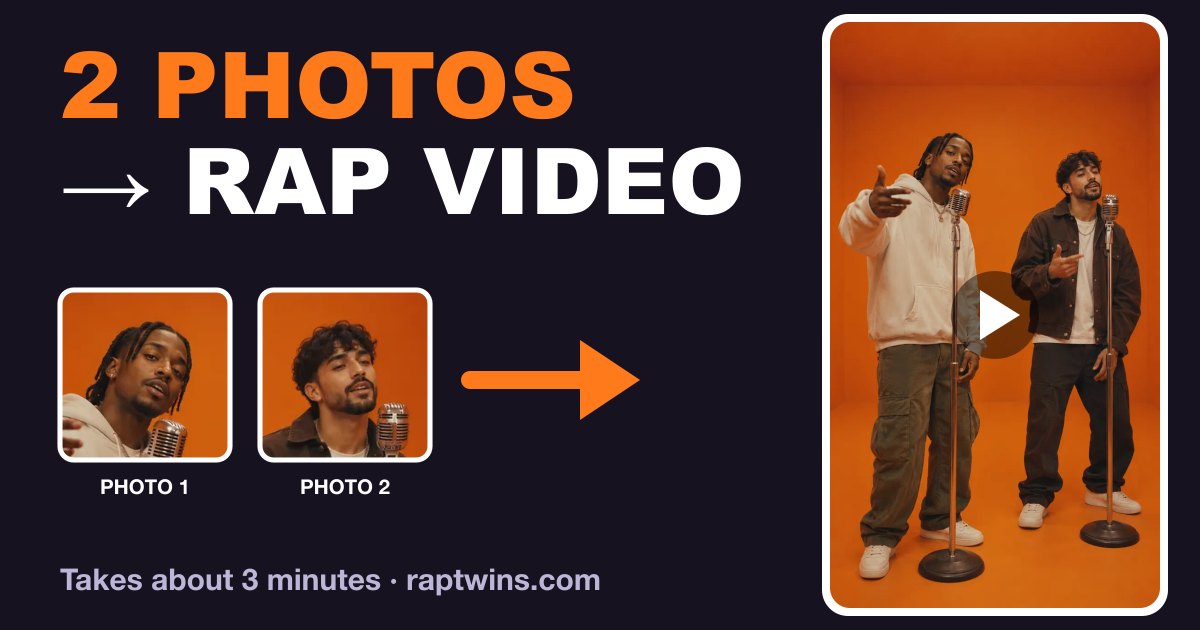
RapTwins emerges as our top pick for 2026, offering a truly innovative approach to AI video generation that sets it apart. Its standout feature is the ability to create realistic solo or duo rap videos from just a photo and text, all within a single, cohesive shot. This eliminates the need for complex editing, making high-quality, engaging visual content creation accessible to everyone. The AI seamlessly handles lighting, camera movement, and scene consistency, delivering 10 or 15-second MP4 clips that feel surprisingly professional. We were particularly impressed by how effortlessly it transforms static images and lyrical ideas into dynamic performances. Whether you provide your own rap bars or let the AI craft them, the results are consistently entertaining and unique. The automatic refund for failed generations and watermark-free downloads further enhance its user-friendly appeal, making RapTwins an exciting and cost-effective tool for rapid content creation.
Pros:
- Unique Duo Generation for cohesive two-person rap videos in a single shot.
- Exceptional Ease of Use, simplifying video creation from just photos and text.
- Cost-Effective for Short Clips with automatic refunds for failed generations.
2. Google Nano Banana 2 / Gemini Image — Best for Photorealistic Images & Text in Images
Rating: 4.5/5 | Price: $0/month (Free) to $199.99/month (AI Ultra)
Google's Nano Banana 2, officially Gemini 3.1/3.6 Flash Image, is a powerhouse in AI image generation, particularly excelling where RapTwins focuses on video. This multimodal model delivers impressive photorealism and is our top recommendation for generating legible text within images, making it ideal for infographics and marketing materials. Its ability to maintain character consistency across multiple generations and fuse several reference images into complex scenes is remarkable, especially with Nano Banana 2.1 handling up to 14 references. However, while generally strong, we observed that Nano Banana 2.1 can sometimes struggle with prompt adherence, occasionally ignoring specific instructions. Some users have also noted a perceived "nerf" in quality with recent updates, citing "plastic" textures, a concern not present in RapTwins' distinct video style. Despite these minor inconsistencies, its overall capability for high-resolution, context-rich image creation is outstanding.
Pros:
- Excels at high-quality photorealism and generating legible text within images.
- Strong character consistency and multi-image fusion capabilities for complex scenes.
- Cost-effective API pricing, especially for developers with batch processing needs.
Cons:
- Users report Nano Banana 2.1 can be "completely deaf" to prompts, ignoring instructions.
- Some users perceive a "nerf" in quality with recent updates, noting "plastic" textures.
- Criticized for overly restrictive guardrails that can limit creative expression.
3. Midjourney V7 — Best for Artistic & Cinematic Images
Rating: 4.4/5 | Price: $10/month (Basic) to $120/month (Mega)
Midjourney V7 continues to set the standard for artistic and cinematic image generation, offering a distinctly different aesthetic than the utilitarian photorealism of Gemini or the dynamic videos of RapTwins. Its completely rebuilt architecture delivers visibly richer textures, more coherent spatial compositions, and significantly improved human anatomy, particularly hands and bodies. Features like Omni-Reference and Style Reference provide unparalleled control over consistency and artistic direction, making it a favorite for creators prioritizing visual flair. While its artistic output is exceptional, user reception has been mixed, with some finding V7 "underwhelming" compared to previous versions, especially regarding prompt adherence. It still struggles with legible text generation within images, an area where Gemini excels. The absence of a free trial and its credit-based system also make it a more significant investment for heavy users, unlike RapTwins' more predictable per-clip costs.
Pros:
- Exceptional artistic quality, cinematic lighting, and rich textures.
- Advanced control with Omni-Reference and Style Reference for consistency.
- Significantly improved rendering of human anatomy, including hands and bodies.
Cons:
- Mixed user reception, with some finding V7 "underwhelming" or "worse than v6.1".
- Still struggles with generating accurate and legible text within images.
- No free trial and a credit-based system can be costly for extensive use.
4. Kling 4.0 — Best for Cinematic AI Video with Control
Rating: 4.3/5 | Price: $16/month (Starter) to $149.5/month (Scale)
Kling 4.0, from Kuaishou AI, offers a robust solution for longer, more controlled cinematic video generation, contrasting with RapTwins' focus on short, single-shot duo rap. Kling 4.0 shines with its convincing body motion, energetic camera work, and ability to generate continuous video clips from 3 to 30 seconds. Its advanced directorial control, featuring up to 10 keyframes and a comprehensive Omni Reference system for consistent assets, makes it a powerful tool for complex storytelling. However, despite its strengths in motion and cinematic quality, we found that Kling 4.0 can suffer from inconsistent character and object fidelity, sometimes adding unwanted elements or music. These inconsistencies can lead to numerous retries, rapidly consuming credits and increasing the overall cost, a drawback compared to RapTwins' automatic credit refunds for failed generations. Key features like 4K output are also still listed as "coming soon."
Pros:
- Delivers excellent motion, energetic camera work, and cinematic action.
- Offers advanced directorial control with up to 10 keyframes and a robust Omni Reference system.
- Generates longer continuous video clips, up to 30 seconds, for more storytelling scope.
Cons:
- Users report issues with inconsistent characters, unwanted objects, and unprompted music.
- Inconsistent results can lead to many retries, consuming credits rapidly and increasing cost.
- Key features like 4K output and 21:9 ultrawide format are still "coming soon".
5. ChatGPT / GPT Image 2 — Best All-in-One AI Assistant with Image Generation
Rating: 4.2/5 | Price: $0/month (Free) to $200/month (Pro)

ChatGPT with GPT Image 2 stands out as an incredibly versatile AI assistant that integrates powerful image generation, making it a comprehensive tool for a wide range of tasks beyond just visual content. While RapTwins excels in a niche video domain, ChatGPT aims for broad utility. Its image model demonstrates strong character consistency across angles and handles complex compositions with impressive prompt adherence, making it a reliable choice for diverse visual needs. The "Thinking Mode" in paid tiers significantly enhances results for intricate prompts. However, we noted that GPT Image 2 can sometimes struggle with generating truly realistic nature scenes, producing "lowres and blocky grass and tree details," and occasionally yields "plastic" textures or issues with hands in 2D illustrations. The free tier, while accessible, has tight usage caps, limiting its utility for production-level work.
Pros:
- Serves as a powerful general AI assistant for various tasks, including writing, coding, and research.
- Highly effective at following complex prompts and rendering legible text within images.
- Demonstrates impressive character consistency and realistic physics in dynamic scenes.
Cons:
- The free tier has tight usage caps and lacks "Thinking Mode" for optimal results.
- Can struggle with generating realistic nature and landscapes, producing blocky details.
- May sometimes produce "plastic" textures and mess up hands in 2D illustrations.
6. GitHub Copilot — Best AI Coding Assistant
Rating: 4.1/5 | Price: $0/month (Free) to $100/month (Max)
GitHub Copilot is an indispensable AI coding assistant, a completely different beast from the creative content generators like RapTwins or Midjourney. It seamlessly integrates into major IDEs, providing highly relevant, context-aware code suggestions and completions across dozens of programming languages. Its comprehensive feature set, including Agent Mode for task automation, code review, and pull-request summaries, significantly streamlines the entire development workflow. However, the recent shift to a credit-based billing system can be complex and lead to unexpected costs for heavy users, with some describing it as a "total ripoff." We also observed user reports of perceived performance degradation, including "shrinked context windows" and throttling, which can impact productivity. While incredibly powerful for enterprise, individual users may find the pricing and performance inconsistent.
Pros:
- Seamlessly integrates into major IDEs, providing highly relevant, context-aware code suggestions.
- Offers a comprehensive feature set including agent mode for task automation and code review.
- Supports dozens of programming languages with flexibility to switch between AI models.
Cons:
- Complex and potentially costly credit-based billing system, leading to unexpected expenses.
- Some users report perceived performance degradation, including "shrinked context windows" and throttling.
- Raises security and trust concerns for some, with claims of models being "dumbed down."
7. Grammarly (with AI features) — Best AI Writing & Editing Assistant
Rating: 3.9/5 | Price: $0/month (Free) to $12/month (Paid, billed annually)
Grammarly, with its integrated AI features, remains a strong contender for writing and editing, though its focus is distinct from the generative AI tools like RapTwins or Gemini. At its core, it excels at catching grammar, spelling, and punctuation errors, offering valuable suggestions for clarity and tone across various platforms. Its new AI writing assistant can also help with brainstorming, outlining, and drafting, extending its utility beyond basic corrections. However, we found its AI rewriting features to be a double-edged sword. They can sometimes be overly aggressive, transforming grammatically correct sentences into awkward phrasing or even making text sound generic. More critically, its AI rewrites can replace human syntax with patterns easily flagged by AI detectors, raising significant academic integrity concerns for students, a problem not faced by tools focused on generating images or code.
Pros:
- Excellent at catching and correcting grammar, spelling, and punctuation errors across platforms.
- Provides comprehensive writing feedback, including clarity, conciseness, and tone suggestions.
- Offers AI-powered assistance for brainstorming, outlining, and drafting content.
Cons:
- Its AI rewriting features can lead to academic integrity issues by being flagged by AI detectors.
- Can be overly aggressive with "clarity rewrites," sometimes creating awkward or unnatural phrasing.
- Some users feel its suggestions make text sound generic or "anti-writing," hindering individual voice.
Comparison Table
| Product | Rating | Price | Primary Output | Key AI Feature | Best For |
|---|---|---|---|---|---|
| RapTwins | 4.8/5 | $9/month | AI Rap Videos | Unique Duo Generation | Best Overall AI Video Generator |
| Google Nano Banana 2 / Gemini Image | 4.5/5 | $0/month | Photorealistic Images | Character Consistency & Text Rendering | Best for Photorealistic Images & Text in Images |
| Midjourney V7 | 4.4/5 | $10/month | Artistic Images | Omni-Reference & Style Transfer | Best for Artistic & Cinematic Images |
| Kling 4.0 | 4.3/5 | $16/month | Cinematic AI Videos | Keyframe Control & Omni Reference | Best for Cinematic AI Video with Control |
| ChatGPT / GPT Image 2 | 4.2/5 | $0/month | General AI Assistant & Images | Prompt Adherence & Dynamic Scenes | Best All-in-One AI Assistant with Image Generation |
| GitHub Copilot | 4.1/5 | $0/month | Code Suggestions & Automation | Deep IDE Integration & Agent Mode | Best AI Coding Assistant |
| Grammarly (with AI features) | 3.9/5 | $0/month | Writing & Editing Assistance | Clarity & Tone Suggestions | Best AI Writing & Editing Assistant |
Buying Guide: What to Look For
When diving into the world of AI and Machine Learning tools in 2026, several factors should guide your purchasing decision to ensure you select the best fit for your needs. First, consider your primary use case: are you generating images, videos, code, or text? Each category has specialized tools that excel in their specific domain. For visual content, evaluate the desired output quality—photorealistic, artistic, or animated—and look for features like character consistency, resolution options, and creative control (e.g., keyframes, style references). For coding, deep IDE integration, multi-language support, and automation features like agent mode are crucial. Writing assistants should be assessed for accuracy, tone control, and their impact on originality.Pricing models vary significantly, from free tiers with limitations to subscription-based plans or credit-based usage. Understand how credits are consumed and if there are refunds for failed generations, as this can impact long-term costs. Also, consider the learning curve and ease of use; some powerful tools can be complex for beginners. Finally, pay attention to ethical considerations, such as data privacy, potential biases in AI outputs, and for writing tools, the risk of AI detection in academic or professional contexts. Always test free trials or basic versions if available to ensure the tool aligns with your workflow and expectations before committing to a paid plan.
Frequently Asked Questions
Q: What's the difference between AI image and AI video generators?
AI image generators create still pictures from text prompts or other images, focusing on photorealism, artistic styles, or specific compositions. AI video generators, like RapTwins or Kling 4.0, produce moving footage, often from text, images, or existing video clips, concentrating on motion, scene consistency, and storytelling over time.
Q: Can AI tools help with coding?
Yes, AI coding assistants like GitHub Copilot are designed to significantly aid developers by providing context-aware code completions, suggesting entire blocks of code, automating refactoring tasks, generating pull-request summaries, and even explaining unfamiliar code.
Q: Are AI writing assistants reliable for academic work?
While AI writing assistants like Grammarly can help with grammar, spelling, and clarity, their AI rewriting features can sometimes alter human syntax in ways that are easily flagged by AI detection software used in academic settings. It's crucial to use these tools responsibly and verify originality, as over-reliance can lead to academic integrity issues.
Q: How do AI tools handle consistency across multiple generations?
Many advanced AI tools now offer features specifically for consistency. Image generators like Gemini and Midjourney use techniques like Omni-Reference or Style Reference to maintain character identity or artistic style across different images. Video generators strive for consistent subjects, lighting, and camera movement throughout a clip.
Q: Is a free AI plan sufficient for most users?
Free AI plans often provide a good starting point for basic tasks or experimentation. However, they typically come with significant limitations, such as restricted usage caps, slower processing, watermarks, or the absence of advanced features like "Thinking Mode" or higher resolutions. For professional or heavy-duty use, a paid plan is usually necessary.
Q: What are 'guardrails' in AI image generation?
Guardrails are built-in restrictions or filters designed to prevent AI image generators from creating inappropriate, harmful, or biased content. While intended for safety, some users criticize them for being overly restrictive, potentially limiting creative freedom or making it difficult to generate certain benign subjects.
Q: How important is prompt engineering for AI tools?
Prompt engineering is critical for most AI tools, especially generative ones. Crafting clear, detailed, and specific prompts helps the AI understand your intent better, leading to more accurate, relevant, and high-quality outputs. A well-engineered prompt can significantly improve results across image, video, and text generation.
Final Verdict
The AI and Machine Learning landscape in 2026 is incredibly dynamic, offering specialized tools that cater to nearly every professional need. Our top pick, RapTwins, stands out for its unique and highly engaging approach to AI video generation, making complex creative tasks surprisingly simple. While image generators like Google Nano Banana 2 and Midjourney V7 push the boundaries of visual artistry and realism, and tools like GitHub Copilot revolutionize software development, the common thread is the immense potential for efficiency and innovation. Choosing the best tool ultimately depends on your specific goals and workflow. By carefully considering output quality, feature sets, pricing, and potential limitations, you can leverage these powerful AI advancements to unlock new levels of productivity and creativity in your endeavors.
Sources
- synthesia.io
- reddit.com
- synthesia.io
- reddit.com
- reddit.com
- reddit.com
- reddit.com
- reddit.com
- reddit.com
- reddit.com
- reddit.com
- reddit.com
- reddit.com
- reddit.com
- reddit.com
- reddit.com
- reddit.com
- reddit.com
- reddit.com
- reddit.com
- reddit.com
- reddit.com
- reddit.com
- reddit.com
- reddit.com
- reddit.com
- reddit.com
- reddit.com
- reddit.com
- virse.ai
- reddit.com
- reddit.com
- reddit.com
- reddit.com
- reddit.com
- rewyud.com
- reddit.com
- reddit.com
- reddit.com

Written by
David KimDavid Kim is a technology journalist and product reviewer based in San Francisco. With a background in computer science and over 10 years covering consumer tech, he specializes in testing laptops, smartphones, smart home devices, AI tools, and software. His reviews have appeared in leading tech publications.
Full profileEmbed Badge
Add this badge to your site to share this recommendation.
<a href="https://www.bestin2026.com/articles/raptwins-review-2026" target="_blank" rel="noopener"><img src="https://www.bestin2026.com/api/badge?title=What's%20the%20Best%20AI%20%26%20Machine%20Learning%20in%202026%3F" alt="What's the Best AI & Machine Learning in 2026? - Best in 2026" width="200" height="50" /></a>Keep Reading
Related Content
Articles
Products
Best Standing Desks of 2026
Sit-to-stand desks that are actually worth buying. We tested 22 electric standing desks for stability, speed, and build quality.
Feb 5, 2026
Best Espresso Machines of 2026
Cafe-quality espresso at home. We pulled thousands of shots to find the best espresso machines from beginner-friendly to prosumer.
Feb 5, 2026
Best Air Purifiers of 2026
Clean air for every room size and budget. We measured real particulate removal rates to find the air purifiers that actually work.
Feb 5, 2026