
Best AI Tools to Turn Manga Into Video in 2026
Your manga is already a storyboard, which is exactly the trap. The tool categories, the four-panel test, and the audio step everyone skips.
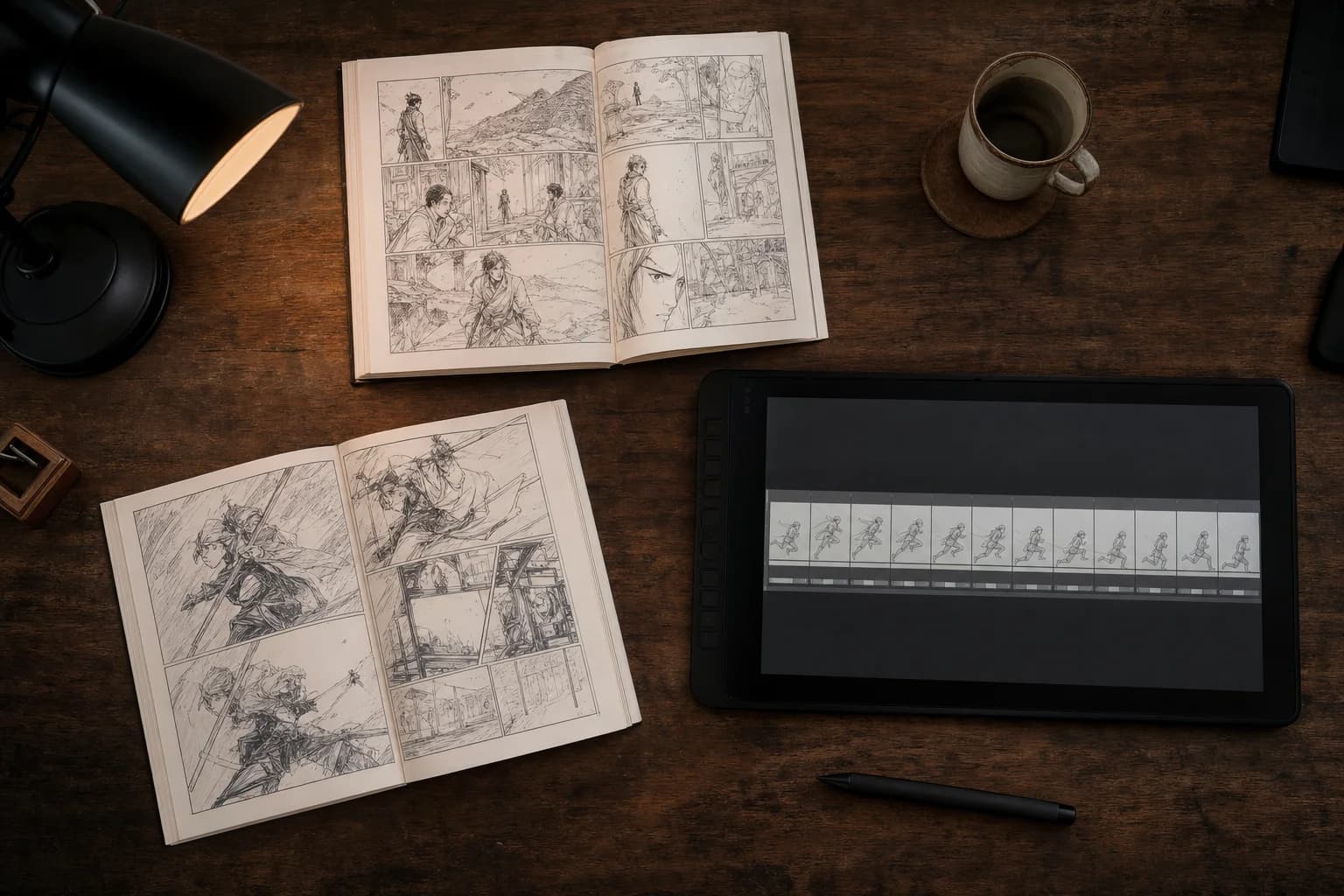
Turning a manga into video sounds like it should already be a solved problem. The panels exist, the framing is done, the pacing is on the page. In practice most attempts fall apart within a few shots, and the reason is specific enough to shop for.
This guide covers what actually breaks, the tool categories, and how to test a candidate before committing a project.
Your manga is already a storyboard, which is a trap
A manga page has done the hard directorial work. Panels establish framing, beat order and emphasis. The obvious move is to feed panels into a video model one at a time and animate each.
That is exactly where it breaks. Single-shot video models generate each clip independently with no memory of the previous one, so panel three's protagonist does not match panel one's. Face structure shifts, hair silhouette changes, a costume detail migrates. The more panels you animate, the further it drifts, and the through-line that made the manga readable disappears.
The useful question is not "can this tool animate a panel." Every current tool can. It is "can this tool keep my character consistent across the whole sequence."
The tool categories
Single-shot video generators. Prompt or image in, clip out. Genuinely good output per clip, and fine for a single hero shot, a title sequence, or a mood piece. Poor for sequences, for the reason above. Cheap, fast, worth owning for one-off shots.
Image-to-video with reference conditioning. You supply a reference image and the tool animates from it. Noticeably better continuity than pure text-to-video, and workable for short sequences of two or three shots. Continuity degrades as shots accumulate and as camera angles move away from the reference — which is a problem for manga specifically, because panel-to-panel angle variation is the whole visual language of the medium.
Multi-agent pipelines. Specialised stages that hand off to each other, with the character defined and locked before any footage is generated. This is the category built for sequence work, and manga adaptation is sequence work by definition.
A tool designed to turn manga into video AI style in this third category runs the job as a chain. OiiOii's implementation puts an IP Designer and Character Designer first to lock the character's design, then a Scene Designer and Storyboard Artist for staging and shot order, then a Sound Director. Every generated shot references the fixed character definition instead of re-deriving it from a description. It routes 28 underlying generation models through that pipeline, so the art style is a choice rather than a lock-in — which matters more for manga than for most content, since the whole point is matching an existing look.
The four-panel test
This settles the question faster than any feature list. Run it before you commit a chapter.
- Pick one character from your manga with a specific checkable detail — an asymmetric hairstyle, a scar, a distinctive collar.
- Generate four shots: a wide, a medium, a close-up, and a rear view turning to three-quarters.
- Put the four stills side by side and look only at face structure, silhouette and that one detail. Ignore how good each image looks.
- Regenerate the weakest shot twice. Does it converge toward the other three, or drift further?
Convergence means the tool references a fixed character. Drift means it re-rolls a description each time, and no prompt refinement will fix it.
Four more checks specific to manga
Style matching. Your manga has a look. A tool with one dominant house aesthetic will fight it on every shot. Test against your actual art style, not a generic anime prompt, and be sceptical of samples that all share a suspiciously similar face.
Black-and-white to colour. Most manga is monochrome and most video output is colour. Decide early whether you are colourising, and check whether the tool makes consistent colour choices across shots — an inconsistent palette drifts as visibly as an inconsistent face.
Panel-to-shot mapping. A panel is not automatically a shot. Some panels are a single beat, some compress an entire action. A tool with an explicit storyboard stage lets you make that mapping deliberately; one without pushes the decision into an editor after the fact, which is the expensive place to make it.
Original IP handling. If you are adapting your own work, you want a tool that builds your characters cleanly rather than pulling toward recognisable existing properties. This is both a legal question and a practical one, since a near-miss of someone else's character is worse than useless.
Audio is half the adaptation and gets planned last
Manga is silent. Video is not. This sounds obvious and it is the step most adaptations skip until the visuals are finished, at which point the options narrow badly.
Dialogue. Speech bubbles carry a lot of a manga's characterisation, and speech bubbles are compressed in ways spoken dialogue is not. A line that reads well in a bubble frequently sounds stilted read aloud, because the reader was supplying pacing that the page implied. Plan to rewrite dialogue for the ear, not to transcribe it. If you are using synthetic voices, budget time for the fact that a voice that sounds fine on one line often sounds wrong on a character across a whole scene.
Sound effects. Manga draws its sound effects, often as a graphic element integral to the panel composition. Translating a drawn effect into an audible one is an interpretive decision, and removing it without replacement leaves shots feeling strangely inert. Decide per scene whether the drawn effect becomes audio, stays visual, or both.
Score. Pacing in manga is controlled by panel size and page turns, neither of which survives into video. Music is what replaces that control. A scene that felt tense on the page will feel flat without it, and this is the most common reason a technically competent adaptation feels lifeless.
Tools with a dedicated audio stage handle this as part of the pipeline rather than leaving it to an editor afterwards. Either way, decide the audio approach before generating the visuals, because shot durations that were chosen without reference to dialogue length have to be regenerated to fit it.
Where to start
The failure mode is adapting a whole chapter first. Do the opposite.
Start with a single scene of three to five panels featuring one character. This is enough to expose drift and small enough to throw away.
Then a title or opening sequence. Short, stylised, high tolerance for interpretation, and genuinely useful as promotional material regardless of how the rest goes.
Then decide about longer sequences, based on what the first two actually produced rather than on what the demos promise.
The bottom line
The category has moved from "not usable for sequences" to "usable for short sequences if the tool locks your character first," which is a real change and a narrower one than the marketing suggests.
Choose on continuity, not on frame quality — frame quality stopped being the differentiator a while ago. Run the four-panel test. Start with one scene. And keep directing the shot order yourself, because a manga's pacing is authorial, and that is the one part no tool infers correctly from the panels alone.

Written by
David KimDavid Kim is a technology journalist and product reviewer based in San Francisco. With a background in computer science and over 10 years covering consumer tech, he specializes in testing laptops, smartphones, smart home devices, AI tools, and software. His reviews have appeared in leading tech publications.
Full profileEmbed Badge
Add this badge to your site to share this recommendation.
<a href="https://www.bestin2026.com/articles/best-ai-tools-turn-manga-into-video-2026" target="_blank" rel="noopener"><img src="https://www.bestin2026.com/api/badge?title=Best%20AI%20Tools%20to%20Turn%20Manga%20Into%20Video%20in%202026" alt="Best AI Tools to Turn Manga Into Video in 2026 - Best in 2026" width="200" height="50" /></a>Keep Reading
Related Content
Articles


Products
Best Espresso Machines of 2026
Cafe-quality espresso at home. We pulled thousands of shots to find the best espresso machines from beginner-friendly to prosumer.
Feb 5, 2026
Best Air Purifiers of 2026
Clean air for every room size and budget. We measured real particulate removal rates to find the air purifiers that actually work.
Feb 5, 2026
Best Standing Desks of 2026
Sit-to-stand desks that are actually worth buying. We tested 22 electric standing desks for stability, speed, and build quality.
Feb 5, 2026